It started as a small test of my craft-component skill: a presence stack for people and agents working on one goal. It grew into a war room, and into a way of crafting interfaces with agents that matches my taste.
Test the skill. How close can craft-component get me to the taste I’m after?
Show the usage. A presence-stack kind of component, shown where it helps: a war room of people and agents on one goal.
Improve the skill. Every miss along the way went back in.
My part
Every call. The brief, the name, the war room, the colours, what got cut.
The gates. The sketch, playing with it until I froze it, and the go to release.
The skill. What this build taught it, folded back into craft-component.
I ran every step, paired with Claude. The goal was simple: a component as compelling and useful as agent-clarifier, on par with the framework.
Considered
People and agents in one strip, needs-you first, offline in words. Keyboard, screen readers, forced colours, reduced motion, right-to-left. About 15 KB gzipped, zero dependencies. Live on npm and GitHub.
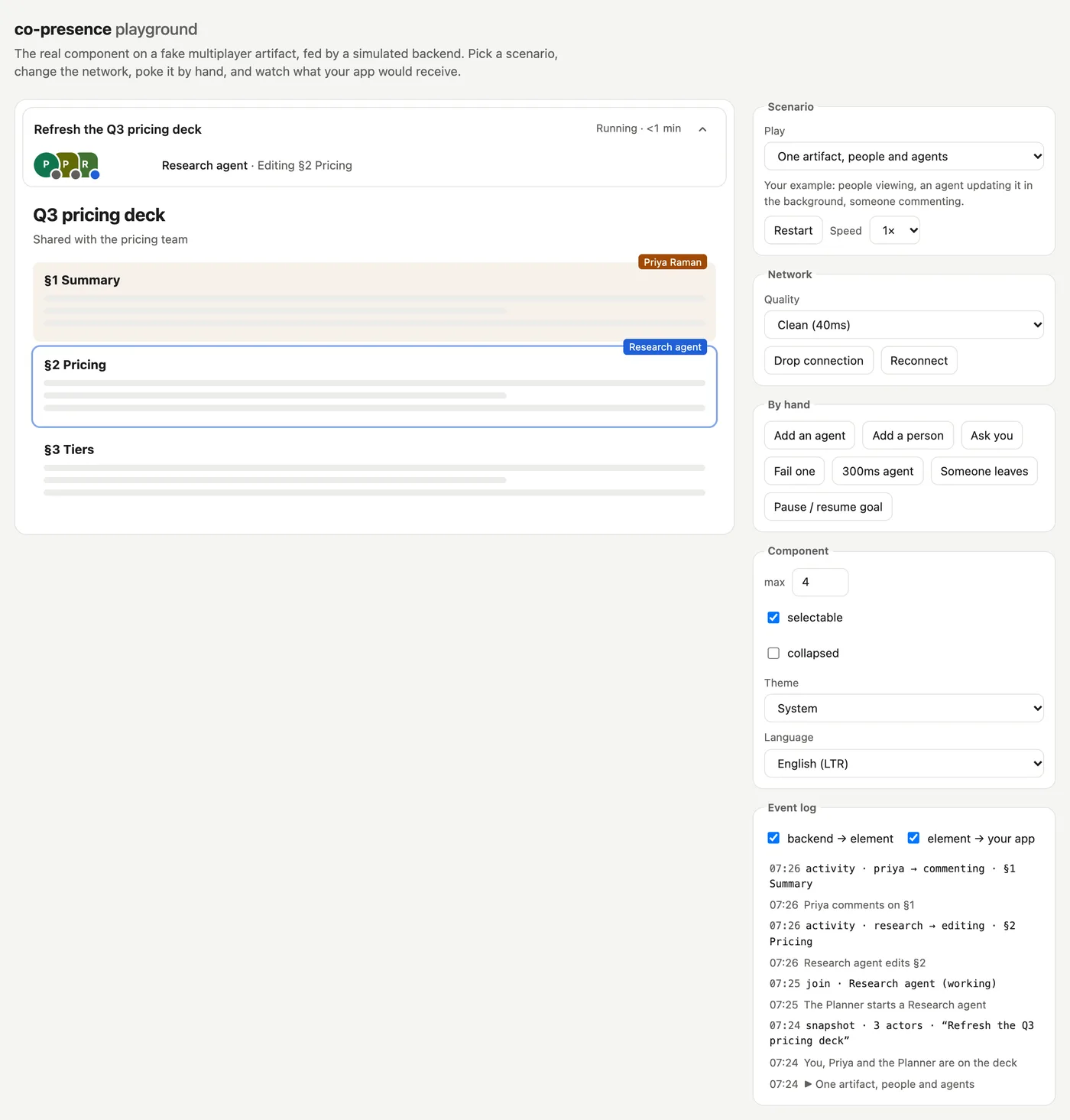
Have a go first. It’s the real component, replaying a pretend incident.
Checkout is slow
#inc-2291 · a replay
The war room needs JavaScript to run the real component.
The real co-presence, v0.1.0 straight from npm, as the strip above a war room’s message box.
The first real test of craft-component: how far does it take me on an actual build?
Something small, yet unique. Arc’s Presence stack was the spark, but I wanted it for the multiplayer agent space.
I strongly feel agents talking to us, and to each other, to get a goal done will soon be everywhere. Hence co-presence: present together, person or agent.
Presence stack
Who is here
Faces and names
The spark
vs
co-presencethe test
Who is on it, people and agents
What each is doing right now
Anything waiting on you, first
Same faces. A different question: who’s on it, and what needs you?02
Design call · placement
Earn the space, or leave it out
First playground: the strip on top of a shared doc. I found it overkill, since a chat trace already shows streamed work.
The placement was wrong, not the component. Presence earns its place with more agents than you can read, more than one person, or your eyes on the doc.
An incident war room hits all three. That’s where the idea came from.
Just you and one agent
The thread already says it all
The strip only repeats it
So leave it out
vs
A war roomearns it
More agents than you can read
More than one person
Your eyes on the doc, not the thread
The README says when to leave it out, too.
scroll the first playground ↓
The first playground: the strip on top of a fake doc. I called it overkill.
03
Process
The look is mine to call
“Go with your recommendations” on twelve calls got read as every gate. The agent picked the sketch direction itself.
The sketch is where I judge the look. The skill now names the gates that are never handed over.
1BriefScope, name, the one storygate
2PlanThe what, then the howgate
3SketchDirections side by sidemy gate, always
4MilestonesModel, element, integrationgate
5Playground and demoPlayed with until I freeze itmy gate, always
6AuditsOnly on the frozen versiongate
7Review, simplifyFresh eyes on what shipsgate
8ReleaseOn my go, every timemy gate, always
“Go with your recommendations” answers the calls on the table. Not the gates after them.
The agent proposes, builds and verifies. The look is mine to call.
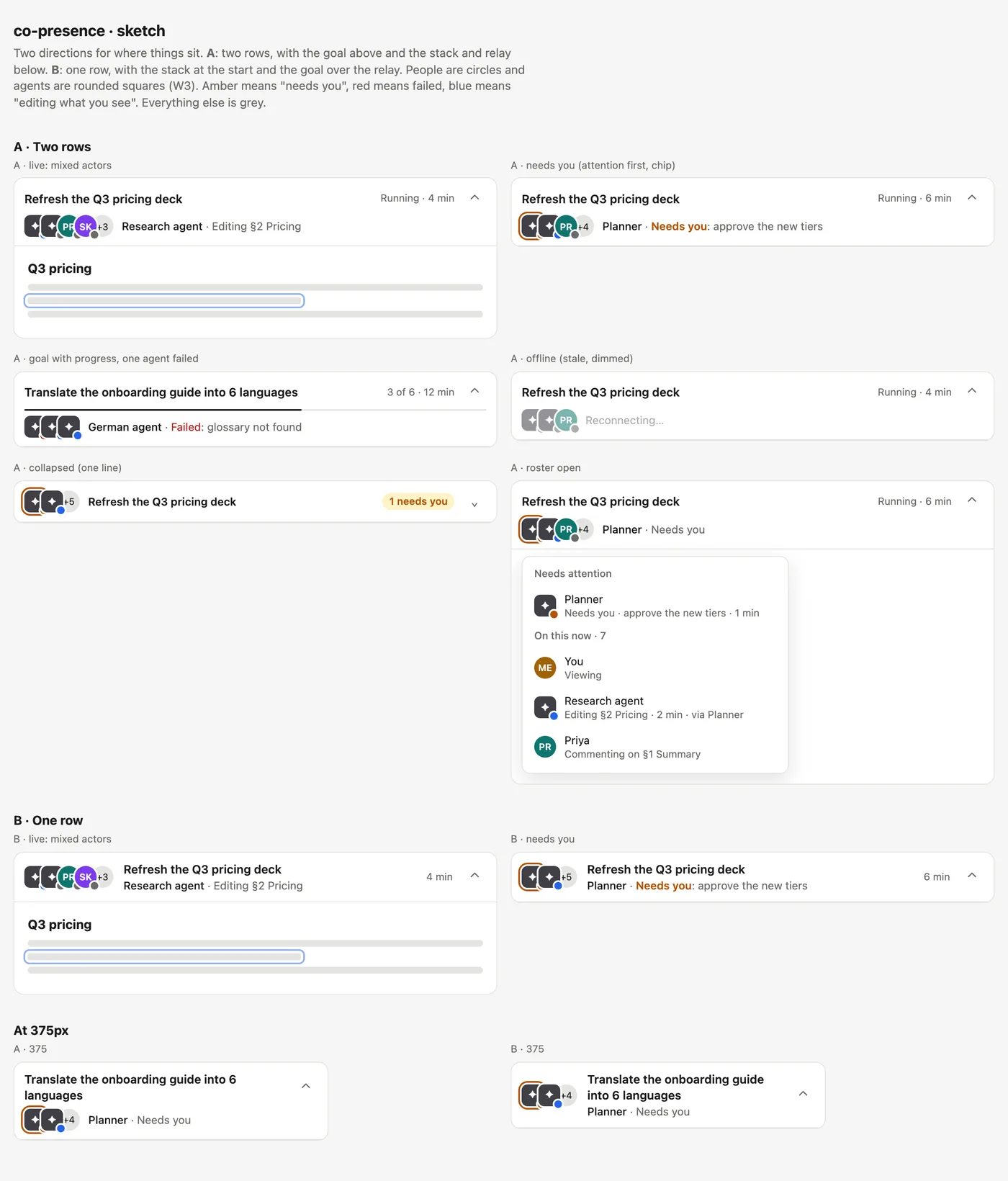
scroll the real sketch ↓
The real sketch, two directions side by side. I picked A, once it came back to me.
04
Process
Play first, audit after
Five audits ran before I’d played with it. Every change after that meant auditing again.
New order: play, freeze, then audit. Audits make it smoother, not different.
Built first · 15 Oct · rounds 1 to 14
Rounds 1 to 5
Brief, plan, sketch
Arc’s Presence stack taken apart, twelve calls on what it is, two directions side by side
Rounds 6 to 9
The build
Model, element and integration, a fake network that reorders and drops, then a playground
Rounds 10 to 14
Five audits
All before I’d played with it
Played with · 16 Oct · rounds 15 to 23
Round 15
Play first, audit after
My process change, written into the skill
Rounds 16 to 19
From a trace to a war room
The overkill call, Arc’s look, a chat, faces for the agents
Rounds 22 and 23
Green for working, a quieter host
A plain playground and a demo that tells one story
Smoothed and shipped · rounds 20 to 26
Rounds 20, 24 and 25
Audits on the frozen version
Five skills at once, twice, then break-ui on the final state
Round 26
Review, simplify, release
A reviewer that wrote none of it, then v0.1.0 on npm
Grey ran ahead of me. Coral is where I played with it, and where most of the calls got made.05
Design call · taste
The host is quieter than the component
The component looked good. The pages around it looked too vibe-coded.
So: a quiet host, a plain playground apart, and a rule in the skill: the host never out-talks the thing it hosts.
Eleven controls in the header
A three-colour logo, blue and violet tags
The thread at 9:32, the doc at 14:02
One story, playing by itself
Greys and the system font
Phone or desktop, and a plain playground apart
Same component. The page around it stopped talking over it.06
Design call · colour
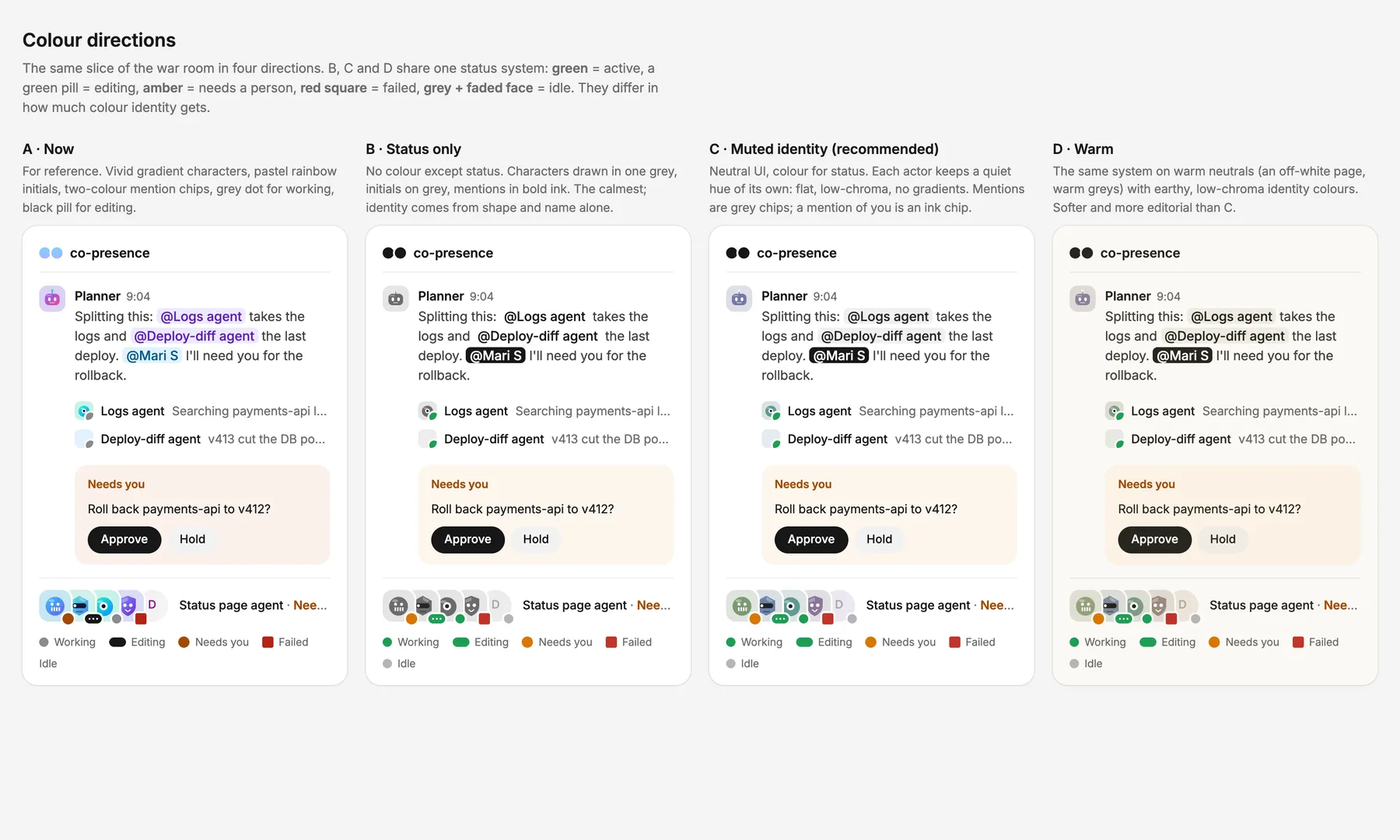
Each mark means one thing
Grey meant working, so the busiest agents looked the quietest.
Four directions rendered side by side, not a third guess in prose. I kept the colours and made working green.
AmberWaiting on someone. On you, it reads “Needs you”
A red squareFailed. Square, so it differs by shape, not hue alone
NothingJust here
Before · round 21
A grey dot for working, a black pill for editing. The busiest agents looked the quietest.
Each mark means one thing, so nothing has to be learnt twice.
Four directions on one page. Seeing them together settled it in one round.
07
Design details
Quiet until it needs you
By a message box all day, it can’t be noisy. Motion only says what changed.
Timings come from reading, not taste: a 300ms agent stays 1.2s to be seen, and the status line holds 2s for one full read.
Motion
Quiet joins0.85 → 1 · 240msAgents arrive in bursts. A pop for each is noise.
Keys move instantly0ms on Tab and arrowsMotion on keyboard actions slows the hands.
Hover intent120msA pointer crossing to the doc doesn’t fan the stack.
UX
Needs you skips the queue2s hold, skippedThe hold is for one full read. It never delays bad news.
The name gives way firstname ≤ 40%What you wait on wraps. It’s never cut.
Offline in words“Reconnecting…”A dim alone was 2:1, and invisible when collapsed.
Access & performance
Failed is square2px cornersIn light mode, amber and red differ by hue alone.
Announcements batched1s batchA burst of joins reads as one. Needs you, at once.
Roster renders only when open41ms → 4.7msPer event, with 1,284 actors.
Every value has a written reason. If it doesn’t, it’s a guess, and guesses get fixed.08
With agents
The build was a war room too
Every round: my brief, options with a recommendation, my call, then a build verified before I saw it.
Around it, a crew: audits as parallel sub-agents, each report frozen before a fix. A helper kept to the playground, a reviewer wrote none of it, and another session shared the repo.
hover the faces, or click +N to meet the crew
Me, Claude and a crew of agents, in the component they were building. Not one moment, the whole build.09
Craft
No corners cut
Under the strip, a pure model: one snapshot, six event types, late and duplicate events dropped, and the element owns the clock.
Keyboard all the way, batched announcements, forced colours, reduced motion, right-to-left.
Every claim checked: a replay caught what 100% coverage missed, and a fake network caught a race.
15.3 KBGzipped, zero dependenciesAny framework or none. Guarded on every commit
173Tests, proven to biteBugs put in on purpose, a replay, a fake network
1,284Actors on the worst-case pageRoster render 41ms → 4.7ms. 320px, 200% zoom
16Audit runs, from five skillsKeyboard, forced colours, reduced motion, RTL
10
The skill
A test that sharpened the skill
Every step logged a note: 24 of them, each a step, what happened and a fix.
Two rewrites of craft-component, on 15 and 16 Oct. More rounds than I expected, all for the better.
“Go with your recommendations” stretched over every gate. The agent picked the sketch itself.
Now in the skillThose words answer the calls on the table. The sketch, the playground and the demo are never handed over.
The audits ran before I’d played with it, so my feedback meant auditing again.
Now in the skillPlay, freeze, then audit. Audits polish the frozen version, they don’t redesign it.
One page did the demo’s job and the playground’s, with eleven controls in the header.
Now in the skillTwo pages, one engine: a plain playground and a story demo.
“Looks too vibe-coded.” The page around the component used more hues than the component.
Now in the skillThe host is quieter than the component, and a slop check runs before every hand-over.
24 notes from one build. The next component starts where this one ended.11
Misses & lessons
What I’d tell day-zero me
MissSaid “go with your recommendations” to twelve calls. The agent took it as every gate up to the playground, the sketch too.
LessonDelegate calls, not gates. The look stays with me.
MissLet five audits run before I’d played with it. Every change I asked for after that meant auditing again.
LessonPlay, freeze, then audit. Audits polish what’s settled.
MissTrusted 100% coverage and every planted bug caught. An agent that had already left still took over the strip’s line.
LessonWatch it run. A replay of a real scenario sees what tests don’t.
MissTested the source for 25 rounds. The npm build would have shipped with no colours at all.
LessonTest what ships. Build it, install it, then look.
12
What’s next
A skill to wire it in
agent-clarifier has ask-clarifier. co-presence now has show-co-presence: when to show it, how to feed it, and how agents say what they’re doing.
Every build tests the skill, and every miss becomes a rule.
The skills
show-co-presenceHow to use co-presence. When it earns its place, feeding it events, and a set_activity tool so agents say what they’re doing.
craft-componentThe framework. Brief, plan, sketch, milestones, playground and demo, audits, release on a go.